





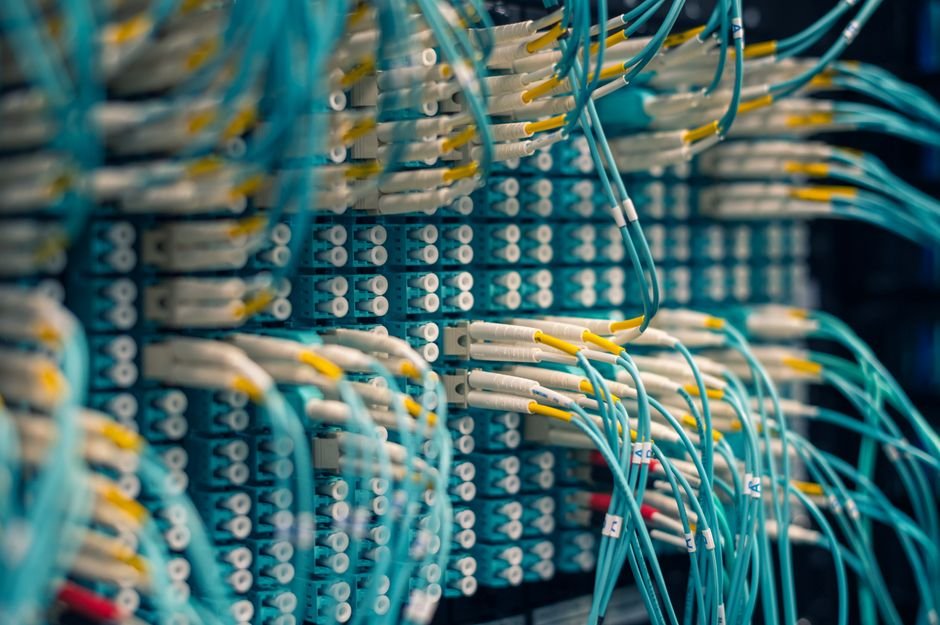

Light travels at its maximum, universally famous speed only in a vacuum — roughly 300,000 kilometers per second. Inside fiber optic glass, light travels meaningfully slower, at roughly two-thirds that speed (around 200,000 km/s), because of a fundamental optical property of the glass called its refractive index, which describes how much a material slows down and bends light passing through it. This isn't a limitation of current fiber technology that better engineering could someday fix — it's a fundamental physical property of how light interacts with the glass medium itself, meaning this speed reduction represents a genuine, permanent physical constant for fiber optic communication, not an engineering target to be optimized away.
This physical constant creates something genuinely useful to understand in network architecture and performance discussions: an absolute floor on latency for any connection covering a given physical distance, below which no amount of bandwidth improvement, better hardware, or software optimization can push the connection, no matter how much money or engineering effort is applied. A request from New York to Tokyo, for instance, has to travel a physical distance that takes light in fiber a certain minimum number of milliseconds to cross — faster processors, better routing algorithms, and higher bandwidth links can reduce every other source of delay in that journey, but none of them can make light travel faster than the fiber's refractive index allows. This is precisely why latency-sensitive applications with a global user base — real-time gaming, video conferencing, financial trading systems — treat physical server placement (having infrastructure genuinely close to users, not just well-engineered infrastructure far away) as an irreducible requirement rather than an optimization nice-to-have; no software fix substitutes for physical proximity when propagation delay is the binding constraint.
It's important to understand this calculator's result as a floor, not a full prediction of real-world latency, because propagation delay is only one component of the total latency a real network connection experiences. Every router or switch a signal passes through along its route adds its own processing and queuing delay — examining the packet, deciding where to forward it, potentially waiting in a queue if the device is busy — and on a long-haul internet route involving many intermediate hops across different networks and providers, this cumulative switching delay frequently exceeds the pure propagation delay from the fiber itself, especially over shorter distances where the propagation component is already small. Real fiber routes also rarely follow the geographically shortest straight-line path between two points — undersea cables, terrestrial fiber runs, and metro connections all follow existing infrastructure corridors (coastlines, highway rights-of-way, existing conduit) that are practical and economical to build along, rather than a theoretically optimal straight line, which adds real additional distance (and therefore real additional propagation delay) beyond the straight-line calculation this tool performs.
Despite these real-world additions, the pure propagation-delay floor remains a genuinely useful reference point precisely because it's the one component of latency that's fixed and non-negotiable — every other source of delay (routing efficiency, hardware processing time, network congestion) is at least theoretically improvable through better engineering, while propagation delay for a fixed distance is not. Comparing a measured real-world latency figure against this theoretical floor gives a useful sense of how much 'engineering overhead' versus unavoidable physics is actually contributing to an observed connection's total latency.